



Most cybercrime investigations do not start with a confession or a witness. They start with a fragment: a wallet address, a screenshot, a timestamp that may or may not be real, an IP that belonged to someone for forty minutes.
The gap between that fragment and a named suspect is where modern investigative work happens. Zerotak delivered a specialized cybersecurity and digital investigation training program for European law enforcement, addressing this gap. The objective: bridge theoretical knowledge and real-world investigative workflows, with structured methodology backed by live simulations on real data.
Here is what the program covered and two of the scenarios participants worked through.
Scope of the Training
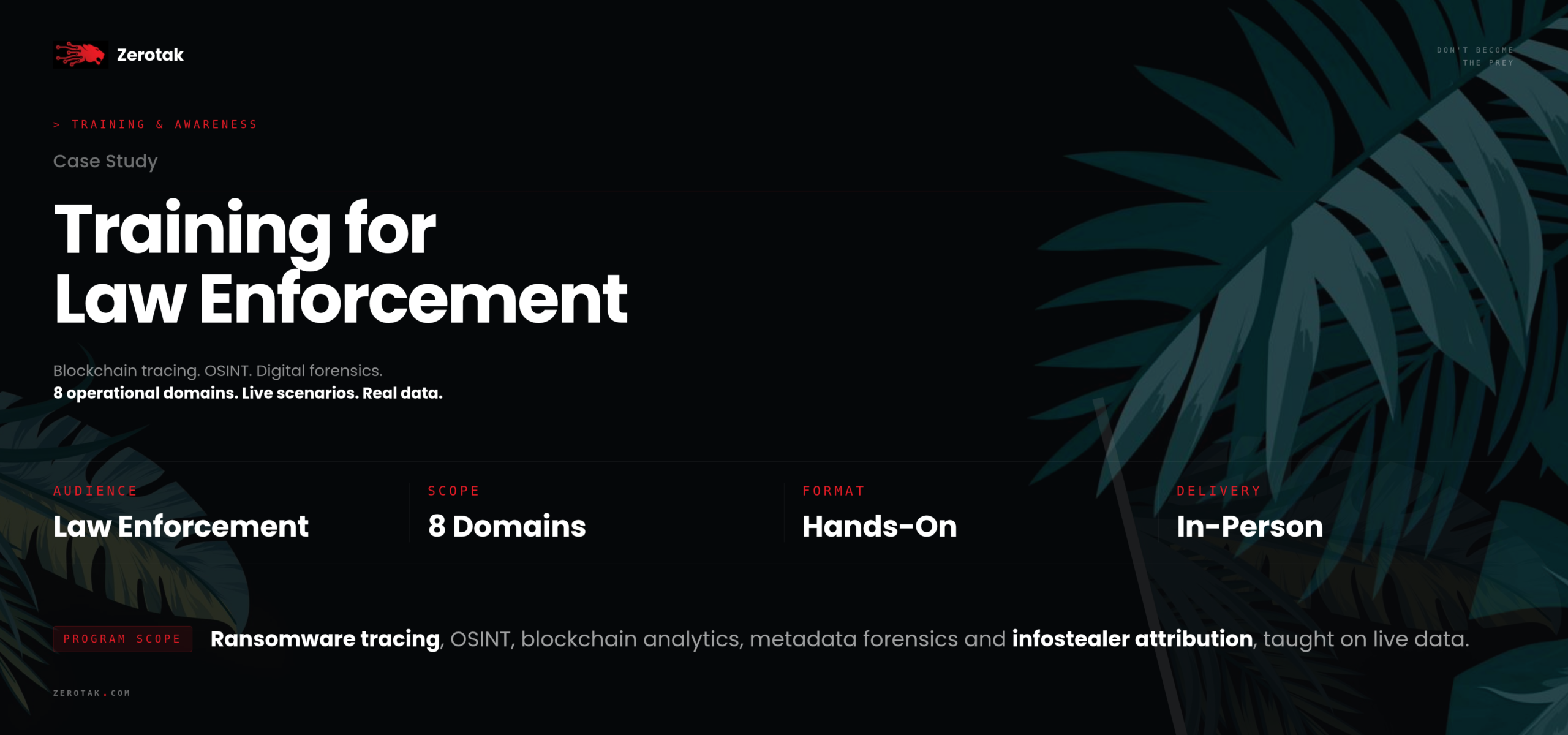
The program covered the following operational domains:
- Blockchain Investigations: tracing cryptocurrency flows, identifying exchanges, understanding mixer behavior, working with analytics platforms.
- Open Source Intelligence (OSINT): structured reconnaissance, social media analysis, geolocation, environmental analysis.
- Leveraging Breach and Leak Databases for Attribution: querying public breaches and infostealer logs, correlating identifiers across datasets, building attribution chains.
- Metadata Investigations: EXIF analysis, document metadata, network artifacts, file system forensics.
- Domain Intelligence: WHOIS pivoting, DNS history, certificate transparency, registrar analysis.
- Ransomware Investigation: actor profiling, infrastructure mapping, payment tracing, leak site monitoring.
- Digital Forensics: evidence handling, disk and memory analysis, mobile device investigation.
- Steganography: detection techniques, common carriers, tooling for hidden content extraction.
Each module included practical investigative workflows, tooling demonstrations, and scenario-based exercises. The format was deliberately weighted toward hands-on work.
Officers do not need another slide deck.
They need to do the work on realistic data.
Scenario 1: From an IP Address to a Named Person
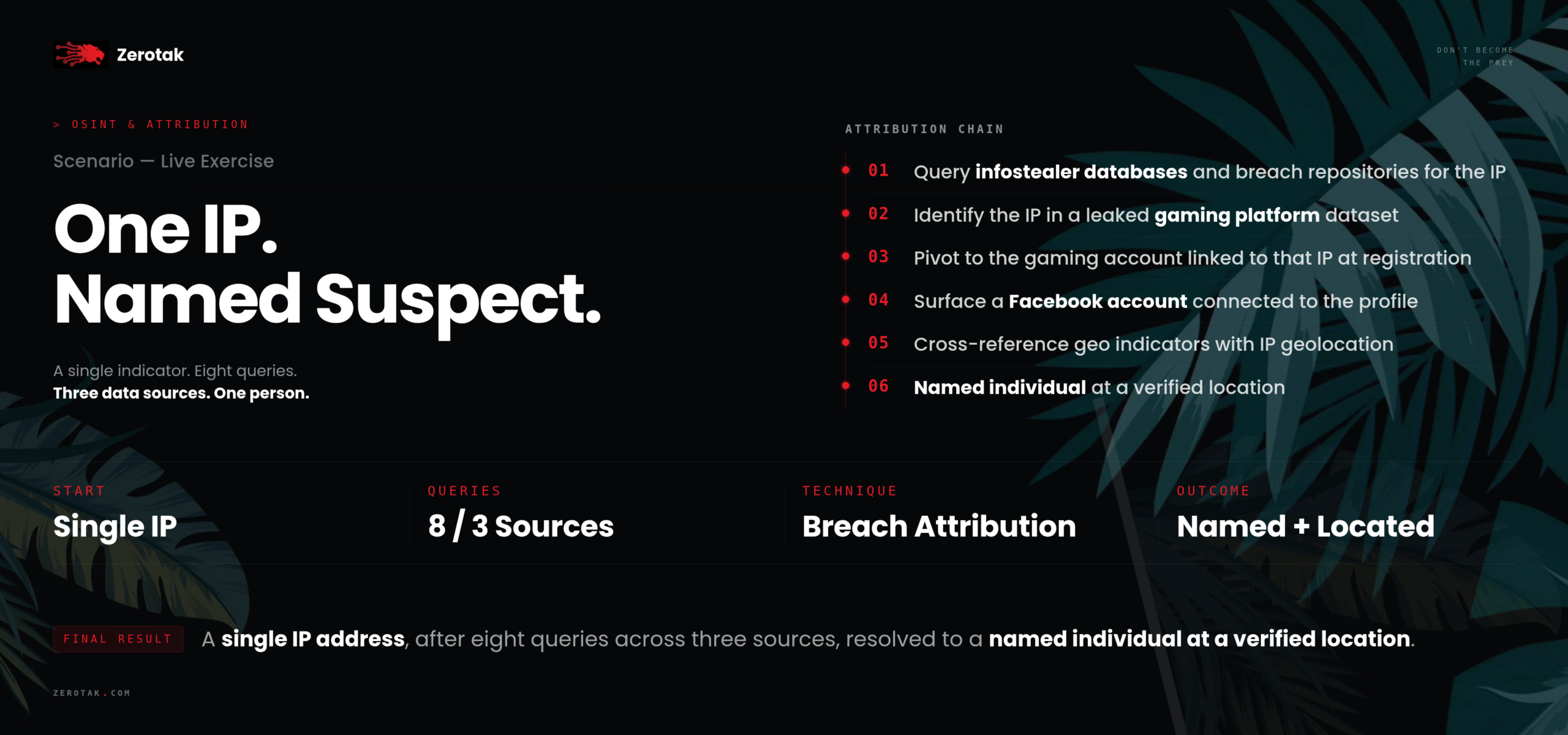
One of the most impactful sessions involved a live exercise with a single starting indicator: an IP address.
Officers worked through it as follows:
- Queried infostealer databases and public breach repositories for the IP address.
- Identified a recent breach where the IP address appeared in the leaked dataset.
- Determined that the compromised data was associated with an online gaming platform.
- Established that the gaming account in question had been created using the IP address under investigation.
- Identified a Facebook account associated with the gaming profile.
- Cross-referenced the geographic indicators from the Facebook profile with the IP geolocation, resulting in a positive location match.
Result: A single IP turned into the full profile.
Two points worth highlighting:
The breach economy is investigative infrastructure now. Infostealer logs and breach databases are no longer just a problem for victims. For investigators, infostealer leaks are one of the most underrated starting point.
Attribution is a chain, not a query. No single source delivered the suspect. Each step confirmed a hypothesis and opened the next. Officers who treat investigation as “run one tool, get the answer” miss the cases that require pivoting across multiple sources.
Scenario 2: Temporal Attribution via Shadow Analysis
During one of the OSINT sessions, participants were given a single photograph and an approximate date. No visible timestamp. No EXIF data.
The question: at what hour was this image taken?
Officers worked through the following approach:
- Identified fixed reference objects in the image such as buildings, poles, vertical structures with known geometry.
- Measured the angle and length of shadows cast by those objects.
- Estimated the sun’s azimuth and elevation based on shadow direction.
- Cross-referenced the geographic location with solar position data.
- Correlated the result with publicly available solar trajectory tools.
- Narrowed down the probable time window when the image was captured.
This is a useful technique in its own right. The broader lesson was the methodology: when one data source fails, the investigation does not stop. Environmental signals, geometric reasoning, and publicly available reference data can reconstruct what metadata stripping was supposed to hide.
The same principle applies to video, audio recordings (ambient noise, electrical hum frequency analysis), and any artifact where the suspect tried to clean obvious traces but left contextual ones intact.
Who Should Train Their Investigators This Way
This kind of program is built for:
- Cybercrime units working ransomware, business email compromise, online fraud, and cryptocurrency cases.
- Counter-narcotics and financial crime divisions intersecting with crypto markets and online laundering infrastructure.
- Internal affairs and intelligence units handling OSINT and digital identity work.
- Prosecutors and magistrates who need to understand what investigators bring them and what is defensible in court.
The common requirement is operational relevance. Theory without case-driven exercises does not transfer to live work. Officers retain what they had to figure out under pressure, not what they read on a slide.
Why This Engagement Mattered
This was not a theoretical program. Participants ran live exercises using the investigative techniques covered in the course: OSINT pivoting, digital forensics workflows, and attribution chaining. Each scenario produced concrete outcomes, under conditions that mirrored real casework. The investigators in the room are not learning to defend a perimeter; they are learning to build a case.
Zerotak‘s training is built around what works in front of a prosecutor, not what looks impressive in a demo.
Get in Touch
If your unit needs structured, scenario-based training in cybercrime investigation, blockchain tracing, OSINT, or digital forensics, talk to us about scope and delivery. We’re certain we can create a program that focuses on your biggest issues.
Just fill out the form and we’ll get back to you.