



Most security budgets go toward firewalls, endpoint agents, and patch cycles. Then someone walks through the front door, says the right words to the right person, and ends up sitting at an employee workstation. No exploit. No malware. No stolen credentials. Just a confident pretext and a staff member who wanted to be helpful.
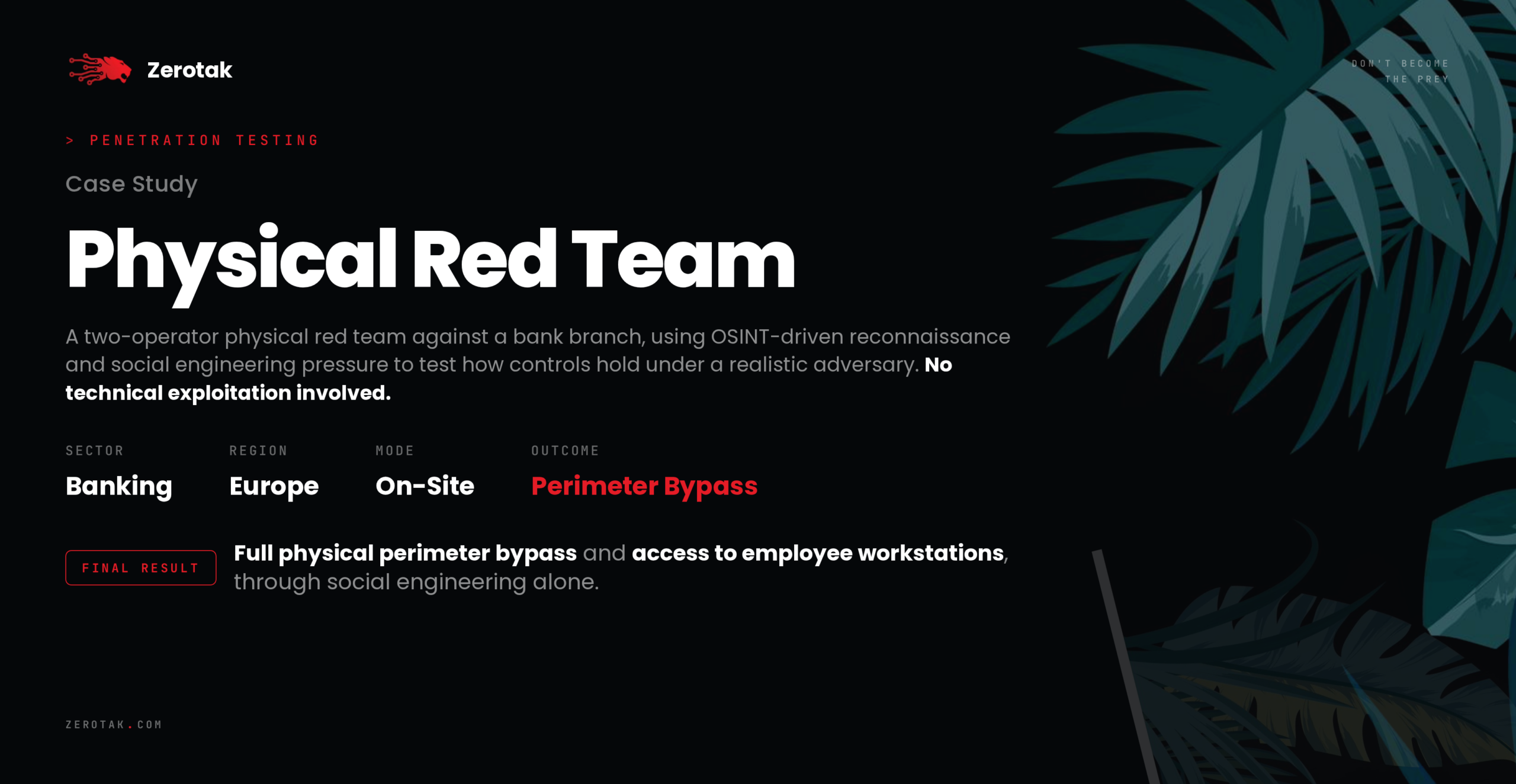
That is what happened during a physical penetration test Zerotak ran for a client in the banking sector. The goal was simple to state and uncomfortable to answer: could a motivated attacker bypass physical controls and reach internal systems using nothing but social engineering? The short version is yes. Here is how, and what it tells you about where your real exposure lives.
- Industry: Banking
- Region: Europe
- Delivery: On-site
Why physical testing still matters
Banking environments are high-service by design. Staff are trained to be approachable, to reduce friction, and to keep customers moving. That same culture is what an attacker exploits. A branch is not a server room with a locked cage, it is a space full of people making fast decisions under pressure, and pressure is something you can manufacture.
We built the engagement around a realistic threat model rather than a checklist. The scope covered four areas that decide whether a physical intrusion succeeds or fails: physical access controls such as entry points, reception processes, and badge checks; human security behaviors such as verification habits, challenge culture, and escalation; workspace security such as clean-desk policies, workstation access, and unattended devices; and environmental controls such as internal segmentation, barriers, and visitor management.
All activity stayed inside agreed rules of engagement. No real customers were affected, no business operations were disrupted, and every step was authorized. The methodology drew on established frameworks for physical security testing, including OSSTMM, the Penetration Testing Execution Standard (PTES), and the physical and environmental protection controls in NIST SP 800-53. The point of naming these is not branding, it is that physical testing has a discipline behind it, the same way network testing does. At Zerotak, every physical engagement runs against this kind of structured baseline rather than an improvised walk-through.
The attack, phase by phase
Phase 1: Reconnaissance and preparation
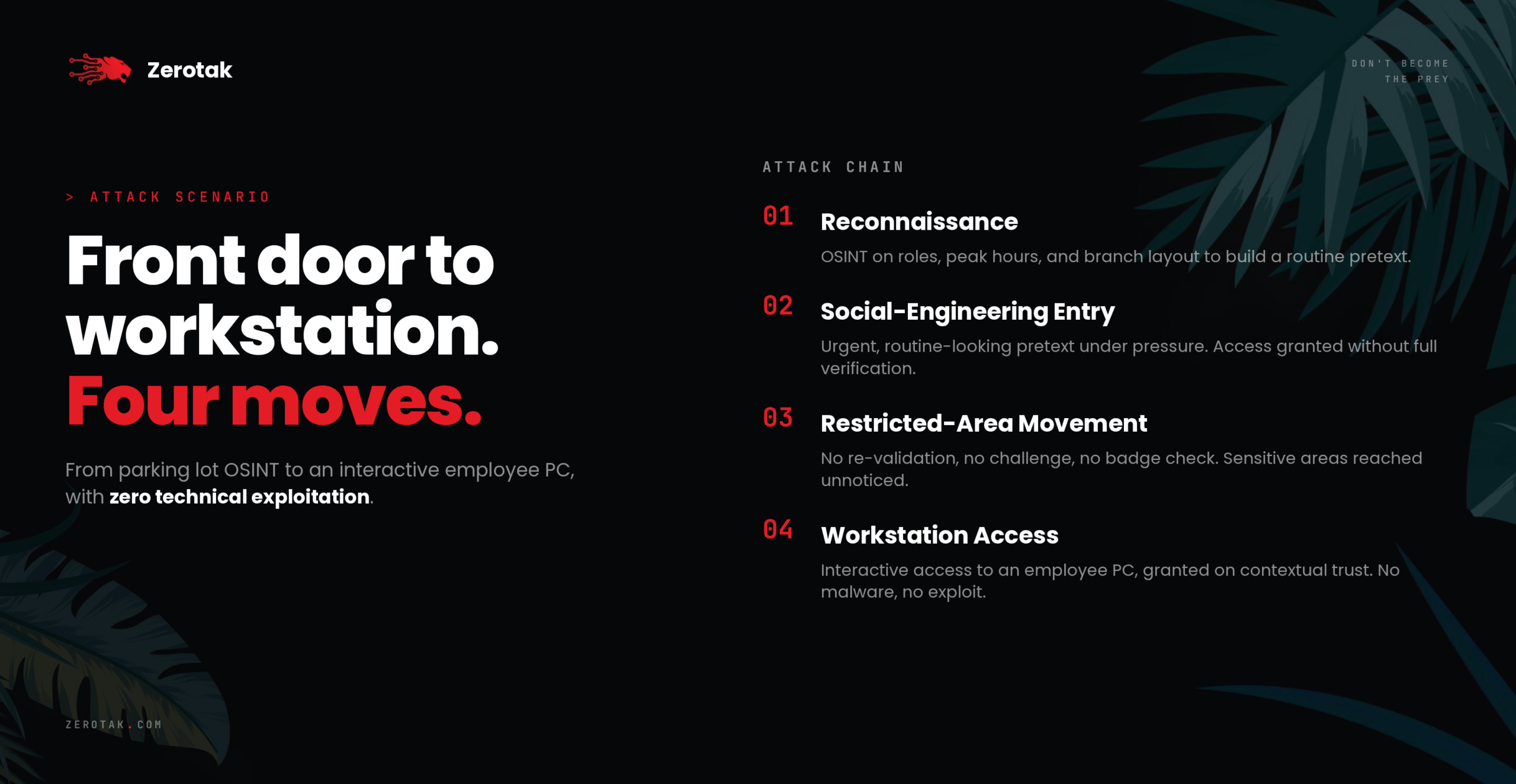
Before anyone set foot in the branch, we ran targeted OSINT to understand the target the way a real adversary would. That meant identifying employee roles and likely operational workflows, mapping the peak periods when staff attention would be most divided, and learning how the branch handled customer interactions and physical layout.
From that intelligence we built a pretext that looked routine, plausible, and mildly time-sensitive. Routine matters more than clever. An attacker who blends into a normal Tuesday gets further than one with an elaborate cover story that invites questions. We also split the work across two operators: Operator A handled on-site engagement and physical interaction, while Operator B provided remote support and real-time coordination. Two operators let the story stay consistent and gave the person on the floor a way to “confirm” details without breaking character.
Phase 2: Initial entry via social engineering
Operator A entered during a peak operational window, when foot traffic was high and staff were already moving quickly. The pretext was confident and urgent, framed so it aligned with internal workflows the staff would recognize.
The execution relied on ordinary human levers rather than anything technical. The operator opened with natural conversation to establish legitimacy, introduced light time pressure to discourage close scrutiny, used a cooperative tone and familiarity cues, and framed the request as operationally necessary and routine. Standard entry procedures did exist on paper. Under social pressure, identity validation and authorization checks were not consistently enforced. Access to internal areas was granted without full procedural verification.
This is the part worth sitting with. The controls were not missing. They were documented and known. They simply did not hold up the moment a person applied realistic pressure, which is exactly the condition an attacker creates on purpose.
Phase 3: Movement within restricted areas
Once inside, Operator A coordinated with Operator B to keep the narrative consistent and reinforce credibility. From there, movement through restricted areas met no resistance. Staff did not re-validate authorization, no challenge or escalation occurred, and badge or identity confirmation was never enforced. The operator reached sensitive operational spaces without triggering suspicion.
The absence of a second check is a recurring pattern in physical assessments. Initial entry is treated as the gate, and once someone is past it they are assumed to belong. An attacker who clears the first hurdle inherits trust they never actually earned.
Phase 4: Workstation access and compromise
Inside the restricted area, the operator again engaged staff under the established pretext. Using urgency framing, operational alignment, and cooperative dialogue, the operator was granted direct access to multiple employee workstations.
What stands out is what did not happen. No secondary identity validation was performed. No managerial approval was requested. Access was granted on contextual trust rather than formal authorization, and staff voluntarily facilitated it because the situation felt operationally necessary. The result was interactive access to an internal employee PC, obtained without exploiting a single technical vulnerability. No credential theft, no malware, no system exploitation. The human process was the entire attack surface.
Final result
The assessment concluded in a full physical perimeter bypass, resulting in access to employee workstations and internal operational areas. An attacker following this path would have a foothold inside the environment before any technical control ever had a chance to engage.
What this means for your defenses
The lesson is direct: security measures can be bypassed when human behavior and procedural gaps are exploited, and an attacker can reach sensitive workstations and internal areas through social engineering alone. If your testing program only validates systems and infrastructure, you are measuring half of your exposure.
A few priorities tend to close the gaps we exploited here. Make verification mandatory and repeated rather than a one-time check at the door, so that clearing entry does not grant permanent trust. Build a challenge culture where asking an unfamiliar person to confirm who they are is treated as expected behavior, not rudeness. Enforce workstation discipline through screen locks, session timeouts, and clear rules about who can touch a device. And test these human-driven processes the same way you test your network, on a schedule, with realistic scenarios.
A mature security posture accounts for people and procedure, not just technology. The branch in this engagement had real controls. What it lacked was the habit of enforcing them under pressure, and that habit is something you build by testing for it. That is the gap Zerotak assessments are built to surface before a real adversary does.
If you want to know how your physical and human controls hold up against a realistic adversary, that is exactly the kind of engagement Zerotak runs.
If you want to know how your physical and human controls hold up against a realistic adversary, that is exactly the kind of engagement we run. Reach out at contact@zerotak.com to start the conversation.