



Most industrial control systems were built to be reliable, not secure.
Modbus and DNP3 are two of the most common protocols running the machines behind power grids, water treatment plants, oil pipelines, and factory floors. They have been in service for decades. That longevity is exactly the problem.
These protocols were designed when the network was air-gapped and locked behind a fence. Nobody expected a PLC to be reachable from the internet. Today, many are.
Why these protocols were never meant to be safe
Modbus arrived in 1979. DNP3 followed in the early 1990s. Both were engineered for a world where the only threat model was electrical noise, not an adversary.
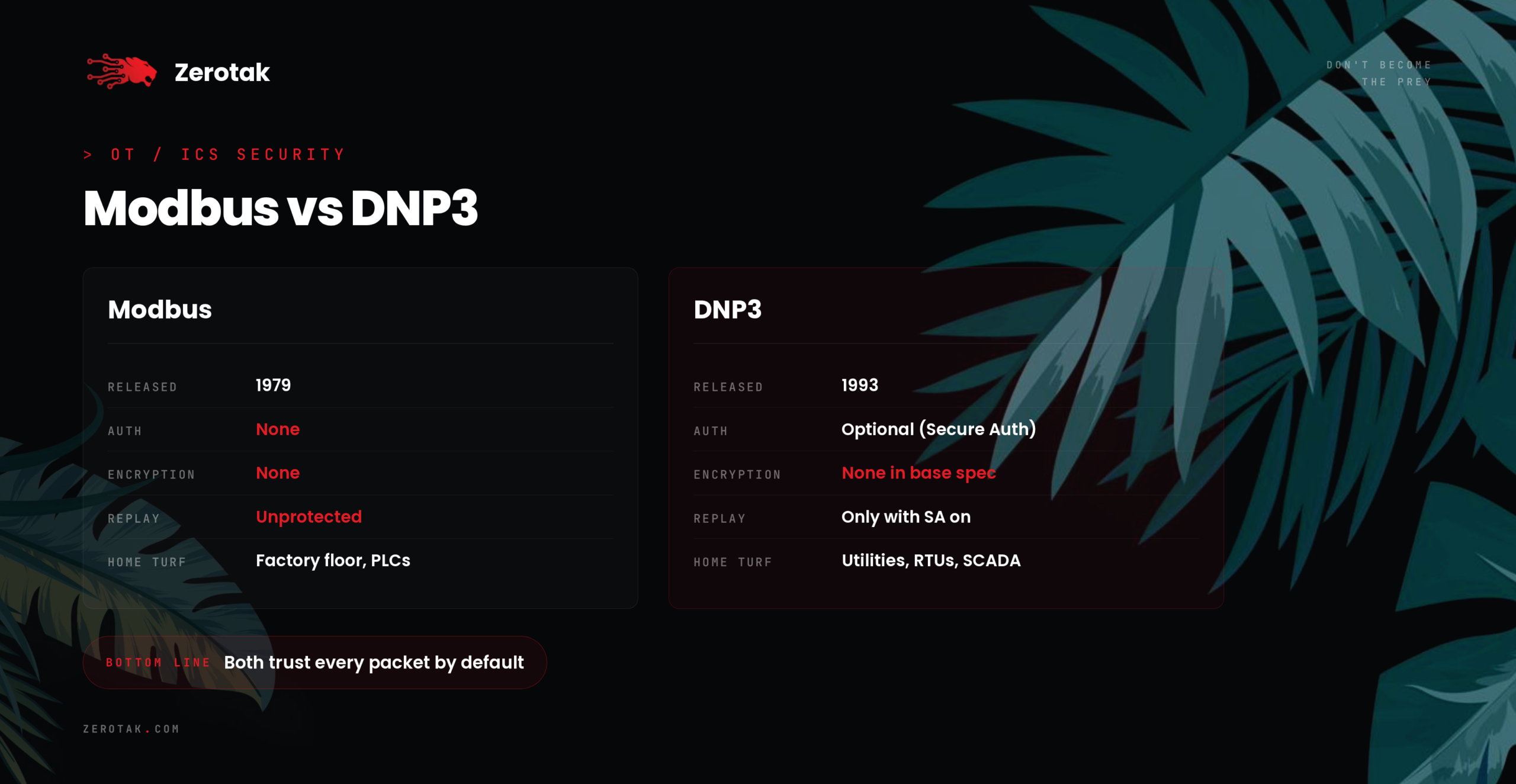
Modbus, in its original form, offers:
- No authentication
- No encryption
- No integrity checks
- No session concept
If a device receives a well-formed request, it executes it. The protocol assumes every message is legitimate.
DNP3 is more sophisticated. It handles time-stamped events, unsolicited reporting, and larger data sets, which makes it common in electric and water utilities. But the base specification also shipped without security. Any device on the segment can read or write registers.
The core issue: these are trusting protocols on networks that no longer deserve trust.
The attack surface in practice
When an attacker reaches a Modbus or DNP3 segment, the options are direct.
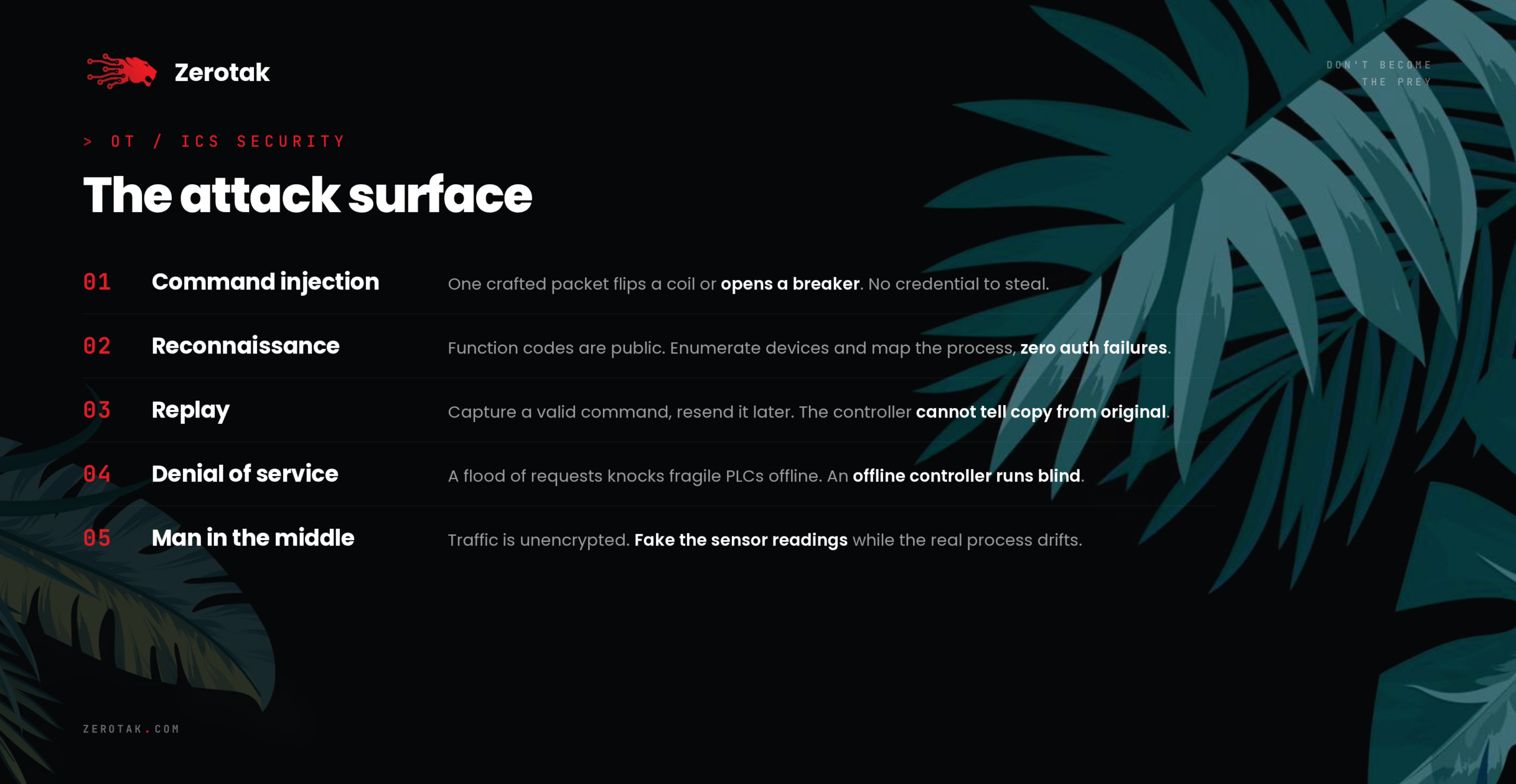
- Unauthorized command injection. A single crafted packet can flip a coil, open a breaker, or change a setpoint. There is no credential to steal, because there is none.
- Reconnaissance and mapping. Function codes and register layouts are documented. An attacker enumerates devices and maps the process without triggering any authentication failure.
- Replay attacks. Capture a legitimate command, resend it later. The device cannot tell the copy from the original.
- Denial of service. A flood of malformed or rapid requests can knock a resource-limited PLC offline, and an offline controller runs the physical process blind.
- Man-in-the-middle. With no encryption, traffic can be intercepted and modified. Sensor readings can be faked while the real state drifts toward damage.
The consequences are not abstract. A manipulated setpoint on a pump, a spoofed reading on a boiler, or a forced breaker trip translates into equipment damage, service disruption, and in the worst cases, safety incidents.
Why “just patch it” does not apply here
IT security assumes you can patch, reboot, and move on. OT does not work that way.
- Many industrial devices run continuously for years. A patch window may come once a year, if at all.
- Some controllers are so old the vendor no longer exists.
- Firmware updates can void certifications or destabilize a validated process.
So the vulnerable protocol stays in place, often for the entire operational life of the plant. Security has to wrap around it rather than replace it.
What actually reduces the risk
You cannot bolt authentication onto Modbus by wishing for it. But the risk is very manageable with the right architecture.
- Network segmentation. Keep ICS traffic on isolated segments. The Purdue model exists for this: separate enterprise IT from operational zones, with controlled conduits between them.
- Protocol-aware firewalls. Deep packet inspection understands Modbus and DNP3 function codes. Permit a read while blocking a write, or allow only specific codes from specific hosts.
- Unidirectional gateways. For the most critical zones, data diodes let information flow out for monitoring while making inbound commands physically impossible.
- Secure protocol variants. DNP3 Secure Authentication (IEC 62351) and Modbus/TCP Security add authentication and integrity where devices support them.
- Passive monitoring. OT-aware intrusion detection watches for anomalies, unexpected function codes, or new devices, without adding load to fragile controllers.
- Access control at the edge. VPNs, jump hosts, and strict remote access policies for any vendor or engineer touching the environment.
None of these fix the protocol. They contain it. That is the realistic goal in OT security: reduce exposure and detect misuse, because the underlying trust model will not change soon.
The uncomfortable reality
Modbus and DNP3 are not going away. Too much infrastructure depends on them, and ripping them out is enormous.
The gap between how these protocols were designed and how they are now deployed is where the risk lives. Every device exposed beyond its intended segment, every flat network, every forgotten remote connection widens it.
At Zerotak, our OT and ICS assessments start from the attacker’s view: what is actually reachable, what commands would execute, and what a real intrusion would cost the process. We map the environment, test the segmentation, and show you where a single packet could cause physical harm.
If your environment runs Modbus, DNP3, or any legacy industrial protocol, Zerotak can help you find the gaps before someone else does. Reach out at contact@zerotak.com to talk about an OT security assessment.