



Every few weeks, someone asks us to run a quick pentest. What they actually need is a vulnerability assessment. Or the other way around.
It’s not a semantics problem. The two exercises answer different questions. They use different methods. They produce different value.
Buy the wrong one, and you waste budget. Worse, you walk away with a false sense of security.
At Zerotak, we run both regularly, often for the same client at different points in their security lifecycle. Here’s how we explain the difference to teams deciding what to book next.
What Is a Vulnerability Assessment?
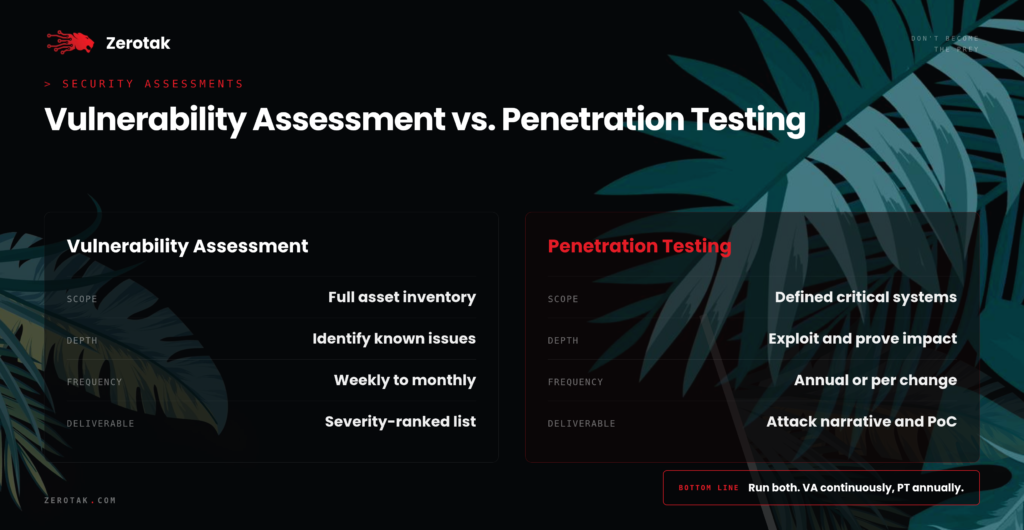
A vulnerability assessment (VA) is a systematic scan of your environment. Networks, applications, cloud infrastructure. All of it. Automated tools compare what they find against databases of known CVEs and misconfigurations. The result is a prioritized list, usually ranked by CVSS score.
The goal is coverage, not depth. A good VA touches every asset in scope. It answers one question: what’s out there that could be a problem?
There is little to no manual exploitation involved. A VA identifies and categorizes risk. It does not prove that risk is real. Because it’s mostly automated, a VA is fast. Hours, sometimes a day or two. That speed is exactly why it fits a recurring cadence, weekly or monthly, without breaking the budget.
What Is a Penetration Test?
Penetration testing (PT) picks up where the vulnerability assessment stops.A pentester defines a scope. Then thinks like an adversary. They actively try to exploit weaknesses, chain them together, escalate privileges, and reach a real objective: domain admin, sensitive data, a foothold in a segmented network.
It answers a different question. If someone wanted in, could they get in? How far would they get?
Where a scanner flags a possible SQL injection, a pentester confirms it. They extract a proof-of-concept record. They document the exact chain an attacker would follow, step by step. This is manual work. Creative work. It takes time.
At Zerotak, our pentests typically run one to three weeks, depending on scope. We follow structured methodology: PTES for full engagement phases, and OSSTMM when the test needs measurable coverage across physical or human channels, not just network endpoints.
The Core Differences
The two exercises differ on almost every practical axis.
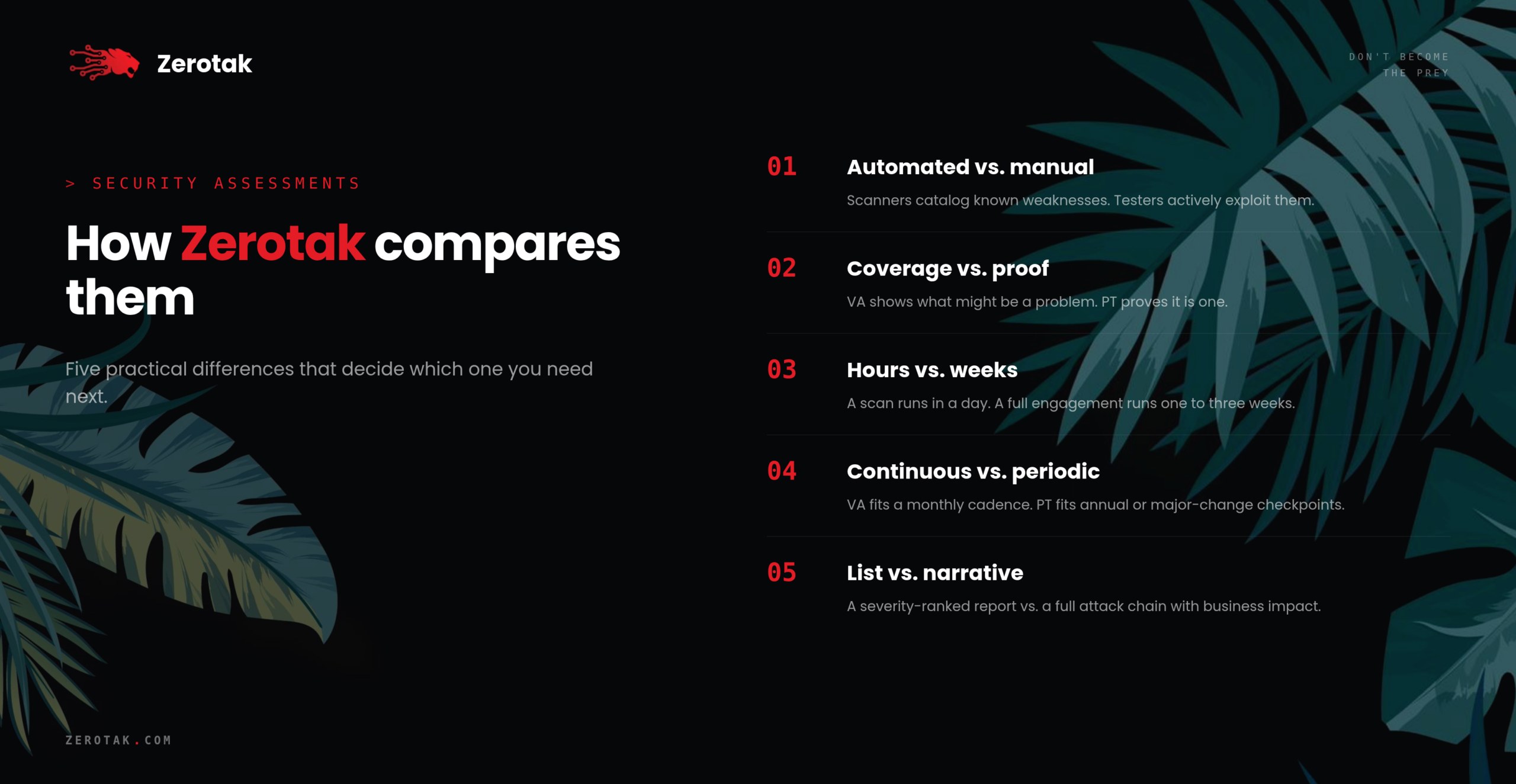
- Method. VA is automated and broad. PT is manual, creative, and narrow by design.
- Outcome. VA identifies potential issues. PT proves and exploits real ones.
- Time. VA runs in hours. PT runs in weeks.
- Cadence. VA fits weekly or monthly scans. PT fits annual or major-release checkpoints.
- Deliverable. VA gives you a severity-ranked list. PT gives you an attack narrative and remediation guidance tied to how the exploit chain actually worked.
- Cost. VA is cheap per run because it’s automated. PT costs more because it’s skilled human time.
Neither replaces the other.
Treating a clean scan report as pentest-equivalent evidence, for a client, an auditor, or a board, is a common and costly mistake. A clean VA tells you there are no known, unpatched issues on the surface. It says nothing about business logic flaws, chained privilege escalation, or whether your team would notice an intrusion in progress.
Only a pentest tests that.
Where This Fits With Other Assessments
VA and PT are not the only options on the table.
- Security audits are mandated, not optional. Think PCI DSS for anyone handling card data, or ISO 27001 for information security management.
- Bug bounty programs crowdsource testing to outside researchers. Pay per valid finding, no fixed timeline.
- Red team engagements go further than a scoped pentest. They test detection and response too, with a full adversary mindset and no announced rules of engagement.
- Purple team work pairs red team offense with blue team defense, in real time, so both sides learn from the same exercise.
Each has a place. Most of our clients start with VA and PT, then layer in the others as the program matures.
How They Work Together
The strongest security programs run both. In sequence. On a cadence.
Vulnerability assessments handle continuous hygiene. The missed patch. The exposed port. The expired certificate, the misconfigured S3 bucket. Caught before it becomes a headline.
Penetration tests validate that hygiene actually holds up against a determined, creative human. They surface what automated tooling structurally cannot see: authentication logic flaws, insecure direct object references, lateral movement paths across a segmented network.
A practical cadence Zerotak recommends to most clients:
- Monthly or quarterly VAs across the full asset inventory
- An annual penetration test on critical systems
- Targeted retests after any major architecture change or product launch
Regulated industries often require both. Banking. Healthcare. Critical infrastructure. Frameworks like PCI DSS, ISO 27001, and NIS2 map to one, the other, or sometimes both. Mapping the right exercise to the right requirement matters as much as running the test itself.
What This Means for Defenders
Deciding what to budget next quarter? Start with the question you need answered. “Are we missing patches or exposed anywhere?” Book a VA. Make it recurring.
“Could a real attacker get from the internet to our crown jewels, and would we catch them?” You need a pentest, scoped around what would actually hurt if compromised.
Neither exercise is a compliance checkbox to file away. The value comes from acting on the findings. Patch what the VA surfaces, on a real schedule. Fix the root cause behind whatever exploit chain the PT team walked. A report nobody remediates is just an expensive PDF.
Zerotak runs both vulnerability assessments and full-scope penetration tests, often as a combined program for clients who want continuous coverage backed by periodic adversarial validation.
Not sure which one your organization needs right now? That’s a fifteen-minute conversation, not a guessing game.
Reach out at contact@zerotak.com